
We Lead Silicon Valley

We've been inventing, productizing, commercializing, and scaling internet products for three decades.
Silicon continues to copy us, not the other way around.
The impact of that is hard to calculate. Conservatively:
It's hard to believe but it's accurate.
Do you want to win?
One of Wun

What percentage of people globally have achieved performance across all three pillars of focus, health, and wealth?
Best in the world criteria
What it takes to be the best in the world:
Media Celebration
Before we calculate probabilities, let's stop and look at the founders that the world and media have glorified for decades:
They couldn't keep their health in balance, and they couldn't keep 100% ownership of their firm. It took at least one of them out early. Beware false gods and Fake Jetpacks, even if every news story and Wall Street glorifies it.
They are not the best in the world.
Calculating Probabilities
Let's look at the math for the percent of people who have achieved this in our global population:
1. 100% Ownership
2. Rule of 50+ Performance
3. VO₂ max > 55
4. Incline Bench > 225 pounds
5. Zero drugs, medicine, alcohol, or steroids/testosterone
6. Mission-Focused > 12 hours per day
Now combine the probabilities to determine the probability of achieving all of them independently, which we would do by multiplying the probability of each together:
Number of People in the World
1 in 40 trillion people
Earth's population is 8.1 billion people, which means it would take 5,000 Earths to find another person who has met all of those criteria.
If you've met all of those criteria, reach out. We're building a council.
Wanna Grow?

Not hitting your metrics? Can't seem to get anything released to PROD? Laying people off? Worried about your business?
Uncomfortable Honesty is a core value.
In that vein, want to know why you're not growing? Gird your loins, cuz this one's gonna hit you where it hurts.
The talent on your team is sub-par. Everyone says, "we've got the best team", "I'd put them against anyone", "we the best music", and yadda yadda.
The problem with this is it isn't true.
If it were true, you'd be releasing major, metric-moving features to production every week like clockwork.
If it were true, your handoffs between team members, departments, and divisions would be as smooth as the gold medal-winning 4x400 team.
If it were true, your metrics would be hitching up, not flat or down.
If it were true, you wouldn't be doing layoffs.
If it were true, you'd have the best people in the world begging to work on what you're building. They'd be thinking about it at night, on the weekends. They'd be talking about it.
It wouldn't be forced. It would be organic word of mouth. No marketing campaigns, no ad buys, no SEO, no growth hacks, no "community building".
Nah, you'd have a team of killers just executing in a way that doesn't feel like work. They wake up every day to play and push the frontier forward.
The numbers are in the rearview because by the time the rest of the world catches up, you're already a decade ahead.
The problem is when you put a team of A players in a team of B, C, D, Z players. Oy, frustrations build like a teapot boiling so hot, it's screaming at you.
People don't want to work anymore. Sure, people want to get that paycheck and so will do the thing you want them to do. Collect-the-check-ers. But they don't jump out of bed. They don't dream about it. They don't do it for free.
They don't do it for the love of the game.
There are only a few of these people left in the world.
If you're out there, holler at me. We need to collect the folks who are left.
Forward it to your friend if he/she/they/it/alien are on the same wavelength.
"We're on a mission" doesn't capture it. It just is. It's exploding out of us faster than we can capture it and manipulate it.
High-Growth Flywheel
The 4 Business Models
What are the four primary business models that Fortune 500 technology companies use effectively to create growth and retention in both consumer and enterprise markets?
Background
We began compiling an Excel file of our career case studies to draw conclusions from past practices that have driven growth, so that we can productize them into repeatable solutions with a high probability of success.
Based on our strategy assessment of Fortune 500 tech companies, the answer has become blindingly clear, as shown in the image below:
Key Findings
Head on over to https://fakejetpacks.com/the-4-business-models/ to read more.
Private Equity's Disruption

How is private equity currently being disrupted, and what is the new playbook to creating value in a much more competitive, fast-moving, global environment?
We've worked with numerous Private Equity investment funds, their portfolio companies, the startups they acquire, and the Fortune 500 strategics they exit to over the last three decades.
The standard playbook for Private Equity has been financial engineering, perhaps some profit sharing, a few acquisitions, increasing cross-sell / up-sell, accelerating product development velocity, and exiting in about 5 years to the next Private Equity buyer or a strategic Fortune 500 buyer.
3 Disruptive Problems
But the world has changed due to three major disruptive forces:
The businesses that are exiting are achieving a Rule of 50 to Rule of 90 performance and have been utilizing vast amounts of data (public or private), as well as artificial intelligence, to commercialize that data into a product, and updating their brands and positioning to align with modern market needs.
AI Defensibility is top of mind for Private Equity investors, while AI moats are a recurring topic in the startup community. Meanwhile, F500s are implementing AI to empower all employees and stay competitive.
This means that the demand for skilled experience in Emerging Tech product development and commercialization is at an all-time high, and the bar for achievement is even higher.
Companies simply do not have the skills, resources, or capabilities to compete in-house anymore. They are forced to look outside. The problem is that everyone is looking outside and competing for the same talent. It's why Meta is paying $100M compensation packages to these new "pro athletes".
Meanwhile, AI-first startups are growing from $0 to $100M in ARR in 12 months. Thus, the opportunity for building the right AI Product has been proven. But you're not building it.
So the question remains, why would someone with decades of experience building high-growth Emerging Tech products want to work for your business instead of someone else's, or their own?
One of the reasons is core values. People can sniff out when they've been developed by a whiteboard committee rather than a single owner who said, "No, this is what we stand for. And I don't care what the world thinks about it."
It simultaneously attracts and repels the right talent and customers.
So what are you going to do now that you're in one of the toughest competitive environments that has ever existed? You're competing against vibe-coded and AI products that launch and scale weekly, you're competing against people who have been refining their skills for decades, and your financial results are in an existential crisis.
You'd better figure it out, because it's not getting easier. You need to get in the game and start crashing the boards.
Defensibility is not Offense. You don't win games playing defense or cutting costs. You win games by putting more points on the scoreboard than your competitor.
We help companies win.
Fortune 500 (Public Equity): How to Win
Private Equity (Tier 1): How to Win
Startups (VC Private Equity): How to Win
There are plenty more value creation case studies we can share that have worked across industry, size, time horizon, and budget.
You set your own ROI:
But it starts with how big you think. Think small, stay small. Think big, grow big.
The choice is yours.
Introducing Jetpack Products

"What is the product for growth?"
Most of the products in the world today have a mission: to extract as much money as possible from you and provide some kind of utility in exchange, which helps get you over the purchase threshold.
But there aren't many products with a mission to help you grow.
Not really.
Sure, you could say there's Salesforce and Hubspot, but they don't exist to help you grow. They just want you to put text into boxes on a website, have you link one text box to another, and they'll send some emails on your behalf. They charge you hundreds of thousands or millions of dollars per year to make you do all the work putting your company's data into their platform, which locks you into their ecosystem.
Doesn't that seem strange? They're not the ones doing the hard work of growing your company? No, that's on you. It's on you to link together 20 different martech platforms just so you can try to get a sense of how and why someone buys something from you, then do the heavy strategic lift of understanding how to improve.
In this way, Salesforce and Hubspot are not on the hook to create value for you. "Sorry, we're just text boxes," say their customer success team. "But keep giving us your money because we're better than a spreadsheet of names. We give you reports for your weekly sales and marketing meetings. And you've spent all this time setting up workflows, it would be silly to stop paying us."
So, in review: put names and email addresses in a text box, and pay them millions of dollars for that privilege.
Here's the rub, and the reason they aren't putting it on their homepage.
Draw a direct line from a text box in Salesforce to $1M in new revenue.
You can't. Because it's your salesperson interacting with a prospect over calls or email. That's not Salesforce. That's your sales team.
No wonder their Agent Force AI strategy isn't really driving new revenue for them. Why pay them even more money for things that aren't directly linked to ROI.
Is there a more direct way to generate ROI?
Pay $200 this week, get $2K next week. Pay $100K today, get $500K next month. Pay $1M today, get $10M next year.
I'll do those deals all day long and three times on Sunday.
So, we must ask the question again: "What is the product for growth"?
We don't think it exists, not in the form we're describing. But it's something we've been thinking deeply about, prototyping, discussing, and iterating on for years. See our 142-episode YouTube playlist video series on Growth as an example of how we've been exploring this idea (note: some videos are private to clients).
Introducing Jetpack Products
That brings us to Jetpack Products, our current instantiation of how to reduce time-to-ROI and increase guarantee-of-ROI.
Together, it would make something magical. Imagine productizing ROI regardless of who you are or what your company does.
Here's an old adage in high-growth circles:
Launch before you're ready, do lots of tests, then iterate more deeply on the ones that work, start over or go backwards if you must, then go forward faster.
To that end, we've created a new Jetpack Products website to collect component products for driving growth that can be mixed and matched like lego bricks. If you squint your eyes, you could call it a Platform as many of these tools use the same back-end but some are standalone so we can iterate more quickly as ecosystem components.
Here's a screenshot of the components we've built so far that exist as of October 10, 2025:
JetpackProducts.com will get you more info on each of them, and most have videos and some give you a demo. Reach out if you'd like to try them for your own business.
How do I distribute my product on Jetpack Products?
This is something we're considering, but it would have to pass through an assessment first. Some of our clients will have the opportunity to add their product to our ecosystem. But either way, expect us to continue building, combining, perfecting, and releasing new growth-related products that help you win in your market.
30-Day AI ROI Assessment

Artificial Intelligence is not going away. Every high-performing business, regardless of size or industry, is already working on AI initiatives.
The Problem
The problem companies are experiencing, however, falls into three major categories:
Our Experience
In short, we have productized the approach to deriving value from AI and continue to prove its effectiveness. Learn more about our approach and past projects.
Take the AI ROI Assessment
If you'd like to take the assessment, you can navigate to Evergence AI and click the button at the top of the page. You will be emailed your score after completing the short questions.
Apple Vision Air Prototype

Apple's updated product growth strategy is becoming clear:
The physical difference is thinness. The capability difference is in battery life and cameras.
You can get them in Deep Navy with no logo, for an elegant, Parisian look. Or upgrade to the Tom Ford Black colorway for a bolder feel.
The iPhone Pro cameras are required to create spatial recordings (multi-plane, 3D cameras, and LiDAR) to be viewed in Vision Pro. This becomes important as you map the world in a spatial mesh and build out a spatial incentive system.
Either way, the heads-up display helps you optimize your life, as you live it, the spatial speakers and microphone array envelop you in dimensional sound.
The subtle liquid glass interface blends into the lenses and the background, for a more immersive overlay interface.
Consider pairing with the AirPods and Watch for the ultimate environmental experience.
Spatial Use Cases
If you want to keep reading this post, please click the button below to navigate to our new Emerging Tech resources site:
The Growth Problem - AI Paywalls
Overview
Sean presented a comprehensive overview of Bitcoin's product growth strategy, focusing on AI paywalls and the transition from strategy to product development, while discussing key concepts like Atomic Decision Units and Bitcoin Lightning. He explored the challenges faced by enterprise SaaS applications, emphasizing the need for standardized APIs to enable effective AI agent communication and highlighting the vast market opportunity presented by connecting AI with enterprise software. The discussion concluded with insights into the evolving relationship between consumers, enterprise software, and AI agents, including a proposed future system of paywalls and transactions managed through Bitcoin wallets, along with considerations for ensuring AI decision-making trustworthiness.
Next Steps
Bitcoin AI Paywall Strategy Update
Sean presented a follow-up on Bitcoin's product growth strategy, focusing on AI paywalls and transitioning from strategy to product development. He discussed the current state of spatial computing, AI advancements, and Bitcoin's role as a digital currency storage system. Sean defined key terms, including Atomic Decision Units and Bitcoin Lightning, highlighting its advantages for low-cost, high-throughput transactions compared to traditional payment methods.
Standardizing APIs for Enterprise SaaS
Sean discussed the challenges faced by enterprise SaaS applications, highlighting issues such as complex user interfaces, outdated application logic, and varied API structures that hinder integration with other systems. He emphasized the need to standardize APIs to enable AI agents to communicate effectively across different platforms, aiming to reduce decision-making, save time, and lower costs for both humans and SaaS companies. Sean also touched on the vast market opportunity, noting the presence of 30,000 SaaS companies and over half a billion users, and suggested that connecting these two domains could lead to increased profitable growth for Enterprise SaaS.
AI Integration and Economic Challenges
Sean discussed the challenges of integrating AI agents with Enterprise SaaS applications, highlighting the need for a secure, authenticated, and monetizable gateway to facilitate interactions. He emphasized the scale of the problem, comparing it to zeta-scale phenomena like global data created daily and Bitcoin network hash power, and noted that machine use will significantly surpass human use. Sean also explored the fundamental growth issues, identifying that the primary blocker lies with consumers who are facing eroded earnings and increased prices, making it difficult to balance the global economy.
AI Agents: A New Economic Model
Sean discussed the evolving relationship between consumers, enterprise software, and AI agents. He explained how consumers currently pay for enterprise software to improve efficiency and manage data, while enterprise software companies pay consumers to build software (i.e., employees). With the emergence of AI agents, Sean proposed a new model where consumers would pay to use AI agents, which in turn would pay for enterprise software and handle more complex tasks. He emphasized the need to differentiate between consumer and enterprise AI agents, as they serve different purposes and have varying capabilities, security protocols, and privacy considerations.
AI Payment System Protocol Development
Sean discussed a potential future where AI agents and consumers interact through a system of paywalls and transactions, with microscopic payments managed through a Bitcoin wallet and an MP server. He outlined a workflow involving API access, payment verification, and data access, emphasizing the need for a standardized protocol. Sean highlighted the potential for growth through better task handling, consistent decisions, private workflows, and new business models for enterprise SaaS, while noting that this system could benefit from a dedicated product to streamline implementation.
Trustworthy AI Decision Engine
Sean discussed the challenges of ensuring AI decision-making trustworthiness, particularly in the context of hallucinations and unpredictable outcomes. He proposed a deterministic decision engine that uses six key inputs to produce a single output, forming what he calls an "Atomic Decision Unit." Sean explained that this system can be inspected, edited, and improved over time, with the ability to track and understand decision-making processes. He invited feedback and collaboration, offering to share more information.
Project Bitcoin - Product Growth Strategy
Resources
Summary
Sean, the CEO and chair of the company, presented an investment committee report on Bitcoin, discussing its potential as a digital battery and its evolution as an emerging technology. He explored Bitcoin's unique properties, defensibility, and competitive landscape, highlighting its advantages over traditional investments and its potential for growth in the new economy. Sean also emphasized the importance of volatility and liquidity in investing, discussed the product mechanics of Bitcoin, and explored different product types that can be built on top of it, concluding that Bitcoin offers strategic advantages and meets a high bar for success.
Next Steps
Bitcoin Investment Strategy Overview
Sean, the CEO and chair of the company, presented an investment committee report on Bitcoin from a product growth strategy perspective. He compared Bitcoin to a digital battery that becomes more valuable over time as it stores and converts electricity, contrasting it with traditional batteries that degrade. Sean highlighted that in the last two years, Bitcoin's scalability, defensibility, and risk levels have improved, increasing its margin of safety as an investment. He planned to discuss these points further in the remaining slides, emphasizing the company's focus on emerging technologies and consumer brands.
Tech Evolution and Layered Progression
Sean discussed the evolution of emerging technologies, highlighting how they progress from upper layers to lower layers, with only the most practical and sustainable ideas making it to the foundational levels. He used fashion and social media as examples, explaining how rapid changes at the surface often result in only a few concepts being adapted for broader use. Sean also covered the components of tech stacks, including interfaces, sensors, artificial intelligence, and computation, emphasizing the importance of understanding these layers to navigate the tech landscape effectively.
Bitcoin: Evolution and Market Potential
Sean discussed the evolution of digital currencies, focusing on Bitcoin's development and its unique features. He explained Bitcoin's potential market value, its use cases, and its role as both a financial product and an operational fuel. Sean highlighted Bitcoin's supply constraints, price floors, and the ability to store messages, emphasizing its potential for growth in the new economy.
Bitcoin's Value and Ecosystem Growth
Sean discussed the unique properties of Bitcoin as a digital and physical money and energy storage mechanism, highlighting its potential for long-term value retention. He explained the correlation between Bitcoin's capabilities and its growth rate, as well as the concept of indirect power within the network for those who hold more Bitcoin. Sean also introduced the idea of a cash generation engine and capital allocation flywheel, emphasizing the importance of reinvesting excess capital into Bitcoin and focusing on activities that benefit the Bitcoin ecosystem. Finally, he compared the impact of legendary product managers like Steve Jobs and Satoshi Nakamoto, suggesting that Satoshi's creation of Bitcoin was one of the most significant product achievements of all time.
Bitcoin's Market Defensibility Analysis
Sean discussed the defensibility of Bitcoin, highlighting its high score compared to other products he has analyzed. He emphasized Bitcoin's key advantages, including network effects, scale, counter-positioning, and geographic distribution. Sean also compared Bitcoin's market cap to major tech companies like Google, Apple, Amazon, and Meta, noting that while they have similar values, Bitcoin's growth potential is still significant due to its S-curve trajectory.
Bitcoin's Competitive Edge and Risks
Sean discussed the competitive landscape of Bitcoin and other technologies, highlighting how Bitcoin has been outperforming traditional investments and companies like Nvidia. He emphasized that the risk profile of Bitcoin is now comparable to other asset classes, with key risks including governmental laws, climate change, and network vulnerabilities. Sean also noted that volatility, often seen as a downside, actually plays a crucial role in driving the Bitcoin network's growth and resilience.
Bitcoin's Volatility and Global Potential
Sean discussed the importance of volatility and liquidity in investing, emphasizing that while short-term investments may be risky, long-term investments like retirement assets can benefit from volatility. He highlighted Bitcoin's unique feature of sharing profits with users, similar to decentralized retail businesses, and its potential in global payment flows. Sean also explained the product mechanics of Bitcoin, comparing it to social media's viral loops, and emphasized its potential for microtransactions and global payment systems.
Bitcoin's Strategic Advantages for Growth
Sean discussed the value of Bitcoin and its potential for network growth through human behavior hacking. He explained the concept of volatility as value, profit sharing with miners, and the importance of decentralization and fixed supply. Sean then explored different product types that can be built on top of Bitcoin, including consumer, enterprise, and financial products. He highlighted the potential for microtransactions using the Bitcoin Lightning Network, which could be crucial for AI-driven transactions in the future. Sean emphasized that building on Bitcoin reduces expenses and offers a strategic advantage, concluding that Bitcoin is one of the few solutions that meet the high bar for success.
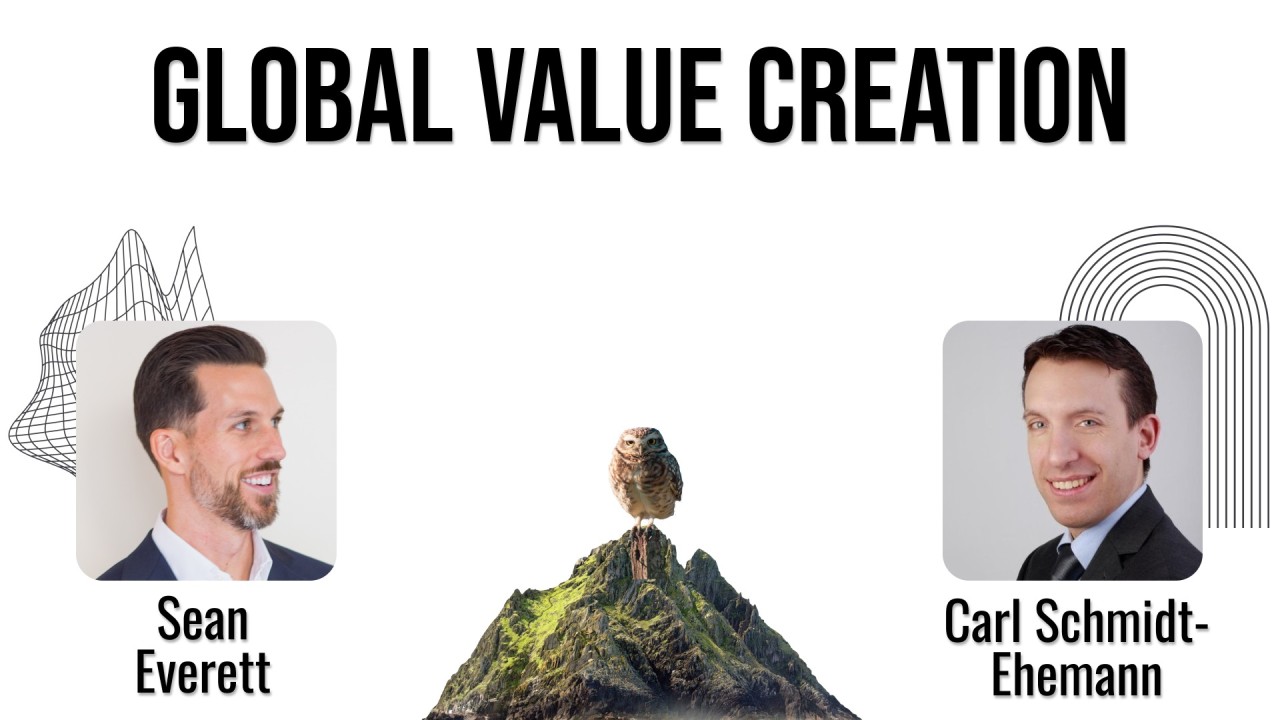
Global Value Creation Part 3, The 3 Immutable Laws & Implementation Details
SUMMARY
In this third and final episode of the Global Value Creation limited series, Sean Everett and Carl Schmidt-Ehemann discuss the three immutable laws of value creation in the mid-2020s: the internet, machines, and money. They emphasize the internet's critical infrastructure role, the rise of machine use over human use, and the significance of digital currencies, particularly Bitcoin.
Carl highlights the need for a structured approach to AI implementation, focusing on processes, structures, knowledge, and culture. They stress the importance of leadership and quick wins to ensure successful transformation.
Sean warns against DIY approaches, advocating for expert guidance to navigate the complexities and seize opportunities in emerging technology.
FRAMEWORKS
ALL VIDEO EPISODES
HOSTS
TRANSCRIPT
Sean Everett 0:01
Hi everybody. Welcome back to the third and final episode of global value creation. I will link the two other earlier episodes from earlier this year in the show notes here, but we're going to kick off straight away, and as we've said previously, we're trying to be the highest value per second of any podcast on the internet. And you know, it's limited supply. There's only three of them, and they'll never be any more. So we'll see if we can meet some of those targets today. So Carl, how are you say hi to everybody.
Carl Schmidt-Ehemann 0:42
Good morning, good afternoon, no matter where you're joining us from and where you're listening. Yeah, I'm good. Thanks, Sean. Looking forward to the third episode and all the things that might be derived from there. So let's kick it off. Shall we?
Sean Everett 0:56
Great, cool. All right, so I'm going to share my screen. I've got something to show today, and then Carl will do the same. All right, can you see my screen?
Carl Schmidt-Ehemann 1:12
Yes, I can.
Sean Everett 1:13
Great. So I've been doing this intersection of capital and computing thing for 31 years now, which is crazy. I got started very young, working on internet products and investing in technology companies in the mid 90s. So here we are, some decades later, and one of the primary things I've learned after many mistakes and fails and potholes and sinkholes and wrong turns is you don't want to bet against technology, and you want to bet against the major trends and macro waves. And then you gotta prioritize your bets, either on the technology you build to help enable the wave or on the companies you invest in with your time, attention, resource, capital, etc, on the leader, or things that help that leader. So with that said, I've come to the conclusion over the years that there's really only three immutable laws as we sit here in the mid 2020s and look out into the future of emerging technology and brand power. So the first one I'll walk through this is the internet, the second one machines, and the third money. And what you'll see is that each one kind of compounds on the last. And these shouldn't sound too foreign to you if you've been paying attention at all to the technology or investment landscape over the last few years. So the first one, the internet will not stop at this stage. I think most people would agree with that in the early Well, in the mid 90s, they thought it was troublesome, especially around the dot com boom at the turn of the century. But at this stage, we've got five and a half billion humans who use it. It's critical infrastructure for everything, and it's sort of like oxygen. You don't miss it until it's gone and it's the only thing you care about. So I won't spend too much time on there the Enable, the enabling opportunity there is compute. You need some energy to power chips and then connecting those chips together. So let's spend some more time on the second one, which is machines. The premise hypothesis finding there is that machine use of the Internet will dwarf human use. We are beginning to see that it's been a growth factor for many years, and now at the rise of AI and agents and computer use tools, IoT, etc, we are at the precipice stage where almost half of the Internet use is from machines. Already. Most people don't understand that. But as we look to the future right, where agents and other technologies operate on our behalf, and some already do. Then, creating and handling hundreds of millions, even billions, of decisions, transactions, computations per second is out of the realm of possibility of what is capable by a human being. So obviously the trend there is artificial intelligence. You may have heard about it, which is really just a rebrand of the word mathematics. So what you're really betting on in this second wave is mathematics that kind of automate some things for humans using the backbone of the internet. So if you don't agree with number one, we're probably not a good fit. If you don't agree with number two, we're probably not a good fit as well. And then number three, we'll call it money. You can call it trade. You can call it transactions. You could call it exchange of value. You could call it kind of whatever concept you want. But really the idea is that on the internet. And between machines. Really, the order of value is computation enabled by energy that transfers something from a single state to another state. So it's kind of a weird thing to say that digital energy is the transaction layer, but that, you know, has reached a sense of scale already. Anyways. I mean, the total value of all digital currencies is almost three and a half trillion dollars, as we sit here today, bitcoins about 2 trillion of that. And then recent legislation has opened up the stable with the genius act for stable coins, which are doing something like, I'm not even going to say it, but it's a lot of money being transacted over digital wires, even ACH payments, while not a digital currency, goes over an internet connected vehicle or transformation medium. And so all taxes that companies and humans pay for actually goes over the internet. So already, money is moving over the internet every day. And so really, Bitcoin is the primary enabler of that, which is it took energy, it transferred it into a digital bits and bytes, and is used for an exchange of values. So obviously, the opportunity there, which is the settlement layer, the slowest pace layer, is Bitcoin. And recently, the latest tap root update enabled pretty much any other stable coin or digital currency to run on top of the back of Bitcoin which runs on the tap on the back of machine, use it shunn On the back of the internet and software. So ultimately, what you're betting on is mathematics, and I think in the future, the companies and the sovereign individuals who win, as well as the machines that win, will ultimately be the ones that invest along some of these paradigms. And yeah, that's kind of where we're headed. So I will pause there. We're a few minutes in any questions or thoughts from Carl. Otherwise, I'll hand the mic over to him.
Carl Schmidt-Ehemann 7:16
Well, I would add just briefly what I'm gonna dig into a little bit more for our audience, is the, of course, as I agree Sean with the general trends and the three laws you pictured, is the requirements, of course, to have a solid implementation. This is like I still remember the.com boom when I was in my late high school years and early college years, where everybody was going crazy on the internet and stuff like that. People investing money in tons of companies they didn't barely understand the business model, and then couple of years later, boom or crash, better said. And I think the potential beneficiaries from AI and all these new technology driven disruptions is massive and huge, but the title wealth will want to be written, otherwise it will crash you. And I think this is, this is one of the most important things that you can learn from all the revolutionary, disruptive aspects since the beginning of the Industrial Revolution almost a quarter of a millennium ago, that the ones who were able to ride the wave, they benefited tremendously, and the others, yeah, they've their competition fall apart. So much for a brief comment on that, and then, yeah,
Sean Everett 8:41
Grab your surfboard.
Carl Schmidt-Ehemann 8:47
So let me share my screen briefly as well. So because thinking of AI as one of the key game changers of our times is as many people still think that we're talking about the usage of a new tool, but to our understanding in the way how we are using it and how We are supporting organizations in the implementation of usage. It's a new mindset. As I said, a tidal wave is coming. Sean digged into that when you think of the internet being used more than 50% by machines already, this is likely, with the more and more sophisticated implementation of AI, to go up to 8090, even 95 99% over time. So it will also bring a radical decentralization of intelligence in organizations like automation, of course, wherever possible, but it requires autonomy on different layers and different levels. And from the very bottom to the top of especially bigger scale organizations. In the old mindset, we were much talking about efficiency, centralized control and task based work. Today it's about real time optimization, distributed intelligence and decision oriented, oriented collaboration, things that were already, let's say, laid out in different strategic business approaches that I was taught 15 years ago at business schools, maybe some at the tech school I went to 25 years ago, but with this new kind of blending all together with the toolbox of AI, with every possibility that's sometimes already on the horizon, sometimes still not.
Carl Schmidt-Ehemann 11:45
Because, as I said, transformation is complex, but it can be structured, and the very first step on that is to recognize that the new strategic approach is needed, like things, the disruptive things of just 2025, tariffs, climate policies, digital disruptions, old strategies basically don't scale any longer, and business models must now integrate sustainability, agility and intelligence as core design elements, and not in a kind of superficial, barely scratching the surface way of handling, but rather deeply embedded and implemented in the roots of an organization and for leaders, and this is one of the most important things to my understanding is leaders must ask themselves and their respective organization, what value do we offer in the World, where AI does 80 plus percent of all operations. So who is eventually making decisions, and from customers, of course, to the organizations to design, to offer processes, products, services, whatever, and then to benefit from that. And so the second part is where I would like to show you a little bit on that as a case study of a company that we've consulted with over the last, yeah, a couple of months, in the regards of a roadmap for implementation, a multinational transport and service company, And in general, in the past, people were thinking of even digitization as a process oriented model and tool, but when you think AI thoroughly, you end up with four different dimensions that are absolutely key for a successful implementation. We're talking about processes, we're talking about structures and steps. We're talking about knowledge and skills, and we're talking about the culture. And of course, when it's getting started, you need to take action and to ensure that you have analyzed and documented all the pain points of your organization of today, and then from that derive. And this is what my slide number two is showing a little bit in an overview, a kind of an impact effort matrix, and a preliminary ranking and valuation of what benefits the organization most in the beginning. So to again differentiate between quick wins, midterm and long term implementation requirements. So, and this is just the example from this organization, I would like to share the most effort, but also the most impact was coming in the regards of empowered responsibilities. So this is what, what I spoke about before, in decentralizing decisions and put the responsibilities from the top more to the bottom, wherever it is required to make a kind of decision the coming culture shift and decentralization that is coming with it. And then, of course, it's about culture. So an organization that was the. That way in the past, sometimes led a little bit more in a top down, sometimes already bottom up approach. Of course, needs to change in the regards of how leadership is executed, as well as how people are encouraged to speak up, to step up, to get budgets, to get the decision making tools at hand so that they don't have to run always to the top to get a decision six months later. Because the higher the speed level becomes with AI, the more likely it is that within a decision of six months you might be even out of business, depending on the size of the organization and the severity of the change and transformation that is coming. Of course, things like the process alignment and the organizational steps and new structure are also the basics and key to success, but the effort for the quick wins, and this is what is important here, outweigh the impact. So this kind of impact effort matrix shall give you an basic insight on what is required to then set up the roadmap and the prioritization on what to do, because when you think it that way, transformation isn't about boiling the ocean. It's about doing the right things in the right order, and that's where the matrix comes in. So maybe from my side as a kind of a bottom line is this age of AI that doesn't wait and transformation doesn't start with technology. It starts with leadership. We're not here to and I think Sean will step in just after that. They might agree on that we're not here to sell hype. We're here to equip you with tools, insights and road maps to lead your organization into an AI ready future, and start with the biggest friction points. It's about encouragement. This is basically the only thing I would like to emphasize for the closure map. It to the matrixes. Let's build your AI future, not in theory, but in real transformation.
Sean Everett 17:24
So then is that 1, 2, 3, 4, 5 in the right priority order? Or is that like order that was for this case study?
Carl Schmidt-Ehemann 17:33
That's right. The 1, 2, 3, 4, 5 was basically the way how this case study and how we, together with the client, came up with the coming from the Yeah, from the old ways of working, how he prioritized in the beginning, the things we first talked about, processes and then went on. And so this doesn't have an order saying one is more important or less important than two or three or four or five, but it was Roger, the summarization of the key elements we were talking about.
Sean Everett 18:07
Yeah, it makes sense. Okay, so a different company, depending on their sophistication level, their place in the transformation effort, the order of operations could be different. I mean, everyone wants to start with low effort, I impact, but it may be technically difficult to get it over the line. So you kind of almost have to, like, have a third dimension here, which is, like, feasibility in each company, because the order, even though you may have, like, here's the right order and theory, like the order for each organization could totally be different. Have you found that to be true?
Carl Schmidt-Ehemann 18:47
I would definitely agree on that. You might. You might turn the phrase in that way, saying this is a global toolbox that works for every organization, but you need to align and tailor made it, make it for every different approach and every different need and requirement. So the general toolbox is good, but you need to take a look and what, what the current pain points and the most important pain points are. Because, why I emphasize the quick wins a little bit before is to celebrate success, because if people think that this won't work, then AI and this whole transformation, which is an absolutely long run effort, will start to wind down. Otherwise. But if you celebrate quick wins, and you see the impacts coming, then people usually start aligning to new models and then continuing down the road. Sense?
Sean Everett 19:55
All right, great. So let's, let's wrap up, do some conclusion statements. Yes, and then we will bid you adieu and set set the audience sail on the seas of the unknown, and hope you got a good ship, strong ship made of steel. Okay, yeah, if you want to pull this off, Carl, we'll do takeaways.
Carl Schmidt-Ehemann 20:24
Yeah, well, maybe the takeaways, from my perspective, is, I would like to quote Hemingway in a certain way. It's if you want to people, want people to build a boat, don't tell don't tell them how to build a boat. But rather to to tell them about their vast interest of the ocean, and people will follow and sweet with within short period of time. And even more, the risks are massive, but the benefits that an organization can derive from that far outweigh to my understanding the risks of it, and even we as a consulting company, we use AI tools in many, many different occasions for us internally, as well as together with our clients, and for our clients and everybody benefiting from that. So I can only encourage our audience. It takes courage, but it's worth doing. Great Love it.
Sean Everett 21:55
Final statements, I've been doing and commercializing emerging technology for pretty much my entire life. This stuff is incredibly difficult, I have a technical degree in mathematics. I barely scratched the service on the depth and breadth of these technologies. After three decades spending pretty much every waking moment thinking about it, researching it, building it, investing in it. So if this is non core to your business. If you're not a tech company, you need help, just flat out, period, even if you are a tech company, because we've had tech companies come to us and ask us a week before their major hardware announcement, like big tech companies like, what should our products do that they spent years building? It just proves to me that very few people in the world have the answer, and I think everyone's trying to figure it out at the moment, but there are principles here and unifying constructs that help you be right, much higher than 50% of the time, and now with tools like AI that are pattern matching and compression engines that can consolidate a lot of information and draw parallels and connections between disparate topics that you can't see, it means blind spots are getting reduced, given you seek them. So there is a way through the darkness, but you need a lamp. So I would caution everybody from DIY, because the sheer opportunity is too great, and if you haven't spent a career understanding where the right levers are you're going to waste time, money, and the window that's open may close before you figure it out. And we're at a precipice here where the monetary premium on assets, like stocks, can completely evaporate and get sucked up by Bitcoin. You're already seeing changes in organizational structures and dynamics, and I'm having conversations with private equity investment committees on whether a business will still be viable at the end of five years that may be growing substantially already, so people are taking this incredibly seriously. And I would just say, Don't DIY, you're going to give yourself a ton of pain. That's it for me. Yeah, I think there's a lot of opportunity there, but you need the right tools in your toolbox in order to capture it.
Sean Everett 24:44
That's it. For me. We're mid 2025, and the back half of this year should be very interesting, especially through the final hold period of the 2020s on to 2030. We'll still be here pushing the ball down the field as they were. So Carl, any last words before we break?
Carl Schmidt-Ehemann 25:02
Yeah, thank you on that. Thank you again on the opportunity, Sean, and anybody who would be interested in learning more and getting some support on that, including a little bit extended version of parts of the slide deck that I was showing today, just reach out to us through our channels that you all know, and then we're happy to assist in the way of like Sean said, not the DIY your process and the transformation on that. Thank you. It's been a pleasure.
Sean Everett 25:35
Great. All right, everybody, have a good one.
#Global #valuecreation #AI #bitcoin #monetarypremium #computation #technology #businesstransformation #energy #emergingtechnologies
Global Value Creation Part 2, Driving Structural EBITDA Improvements
SUMMARY
In part 2 of Global Value Creation, our hosts, Sean Everett and Carl Schmidt-Ehemann, present their respective thoughts on AI and Energy/Sustainability in a novel Income Statement framework. This enables P&L owners and business managers to understand how this new automation technology called Artificial Intelligence will improve structural EBITDA on a component-by-component basis across Revenue, Cost of Goods Sold, each of the major Operating Expense buckets, and Income / Earnings.
VIDEO
FRAMEWORK
HOSTS
Global Value Creation, Part 1
VIDEO
Global Value Creation, Part 1 with Sean Everett and Carl Schmidt-Ehemann
https://youtu.be/VTHvDE8dCFo?si=JhI8pYX6j4lNErcs
SUMMARY
In this inaugural episode of the Global Value Creation podcast, hosts Sean Everett and Carl Schmidt-Emmen discuss the evolving landscape of business, emphasizing the importance of sustainability, energy efficiency, and the transformative role of AI. They explore how emerging technologies are no longer optional but essential for competitiveness, urging listeners to adapt and innovate in response to global changes. The conversation highlights practical strategies for businesses to enhance value creation and productivity while navigating the challenges of a rapidly changing world.
HOSTS
CHAPTERS
00:00 Introduction to Global Value Creation Podcast
02:50 The Importance of Value in Business
06:10 Sustainability and Energy Efficiency
12:00 AI's Role in Business Transformation
17:47 The Impact of Emerging Technologies
27:13 Final Thoughts and Call to Action
AI & Product Strategy: Sean Everett on Value Creation, Tech Leadership & Business Growth
Below is a link to a full hour-long podcast episode produced by a friend in the space, where we discuss artificial intelligence, finding your fascination, maintaining cash flow during difficult operating environments, niche markets vs saturation, the risks you don't see coming, and how the intersection of startups, private equity, and public companies achieve macro-economic value creation:
https://www.youtube.com/watch?v=t4dh_WsaQjg
If growth is dampened, results are not being achieved, or your product is falling flat in the market, you may have the wrong team, the wrong product, or the wrong strategy.
--Sean
Emerging Tech Add-Ons

In this memo, we discuss the different approaches companies are taking to incorporate emerging tech solutions (AR, AI, Cryptocurrency, Blockchain) into their existing businesses and products.
Do you start from the perspective of Bitcoin and then add AI? Do you start from the perspective of enterprise SAAS and then add AI? Do you start from user experience with 2D and 3D interfaces and then plug in Bitcoin and AI?
These approaches, as we've seen when new technological disruptions emerge, provide incremental value but not 100x value.
When the iPhone was released, porting web pages to the iPhone wasn't what ultimately delivered the most value. Instead, it was the rise of always-on social networking and work. Media creation, sharing, and consumption.
Similarly, we need to view the convergence from the perspective of multiple inventions, commercialized at scale, coming together to create something altogether new and different.
We have a thesis, user experience requirements, technical architecture documents, brand, team, and partners identified that are likely to result in realizing this product vision spec. However, it's proprietary intellectual property, and as such, we cannot give it away in this forum. It will also take time to integrate all the existing tools, teams, and technologies together. Which means it's not as fast as bolting on AI to the existing product.
We believe much of the world will approach this from an "add-on" perspective. They have invested time, money, and reputation into the existing product and service and are wrestling sunk costs, and how to do the lowest effort, highest impact thing. It will look like:
It's not the end-game, it's the next step.
--Sean
AI Agents Paying Bitcoin

In this memo, we describe what AI Agents are, how they're using similar sub-systems as cryptocurrencies, and how they are work together.
How It Works Summary:
Depending on whether you work in the ad industry, this might sound incredibly familiar or incredibly foreign. Let's start with the familiar.
Growth marketers log into Google or Facebook's advertising center, upload an image and text, set a daily budget, and push the start button to try to get people to buy their product or service.
That's how Google and Meta make all their money. Theoretically, you could call this an AI Agent because that's what they are. You give them some control to make optimizations across ad units and creative (i.e., A/B testing) to drive higher performance. It's used at a global scale inside nearly every major company in the world.
So why can't you have one that works for you outside of this one use case? Well, you can and the tools are being built now. But the difference is you'll need micropayments to enable some of these workflows and likely need streaming payments.
There are two solutions for that, both on the Bitcoin layer 2 Lightning Network. One is Strike by Jack Mallers which has enterprise-grade software in a consumer-friendly app backed by his own Bitcoin treasury, and the other is Lightspark by David Marcus of Paypal and Facebook fame, backed by major Venture Capital firms.
I'll tell you why these tiny, streaming payments are a fundamental requirement using a simple story. I wrote a book and sold it for $1, and Stripe took 35% of that dollar, leaving me with $0.65. That's a huge tax that should not be required. Moving to Bitcoin's Lightning Network means I pay $0.001, leaving me with $0.999. This represnts a 35% improvement in gross margin for my business.
The marginal cost of these AI Agents will be the computing power required for each calculation, each step, and each job they do. Each of those has an energy cost, a battery storage cost, a chip cost, an operating system cost, and an internet cost. Essentially, cloud computing. That is calculated on a per-second basis currently, but we could go lower level and calculate on a unit-of-compute basis. Each unit of compute may cost $0.00001 so we need a way to pay in real-time that doesn't charge a transaction fee of $0.35, which would be 35000x more expensive.
Thus, you could have an AI Agent theoretically run for you 24x7 as a mini business:
You need internet-native AI and internet-native currency to do this work, and there are a lot of ways to earn more than $300 for tasks on Fiverr and Upwork, especially for something running 24x7x365.
We fully expect this will be one of the shortest paths to quick cash flow for creative internet engineers.
Do you really want customer leads or would you rather Wake Up To Money™:
https://www.youtube.com/watch?v=u1Fjvhh3c_0
We'll leave you with a few diagrams, one from the AI world and one from the Blockchain world.
As you can see, these are nearly the same use case, just applied in different emerging tech domains. Prompt = "Go somewhere else to get facts and incorporate those facts into my AI or Blockchain transaction".
As time goes on, our vocabularies will converge as the technologies do. And you'll find the ones who win are the ones who message using plain language that busy people can understand.
--Sean
Pace Layering

In this article, we describe what Pace Layering is and why it's important as a framework for understanding emerging technology development and adoption cycles.
The best way to understand the concept of Pace Layering is to view the following image:
For those who are unable to see it, we will describe what's in this black-and-white image. There are a series of concentric rings with Nature at the center, then moving outwards Culture, Governance, Infrastructure, Commerce, and Fashion. Details of each layer are as follows:
Elements closer to the center of these rings are fundamental structures upon which we can build knowledge, shared understanding, and engineering principles and use them to build a society. Without our understanding of mathematics, we could not have built computers or sent rockets to the moon. Similarly, we can't build stable engineering systems on top of fashion. Sure, we can change the design of the space suits, but that design doesn't get us to the moon.
Another mental model for pace layering in the form of a house. As shown in the image below, you can see how the innermost rings, like “stuff,” change more rapidly than the outermost rings, like the foundation and structural elements.
As you think about Bitcoin, it has its primary layer 1 protocol, the layer 2 rollups that allow for faster and cheaper transactions around the outside of that, and more traditional businesses in layer 3 outside that like exchanges. This perfectly maps to Pace Layering. Layer 2 and Layer 3 businesses, and even other cryptocurrencies like Ethereum are faster-moving, prototyping layers that eventually get consumed down into the most fundamental layer (i.e., the Bitcoin Blockchain).
We can extrapolate this to all forms of emerging tech. At this point, SAAS is a known quantity and safe, but two decades ago, it was a novel idea. Instead of putting software on floppy discs or CDs, we put the software on a website that is constantly updating, charge a monthly price so we have continual cash flow, and work on attracting new customers while retaining the old. Investors look at that today and want stable recurring revenue, growing EBITDA, and 90%+ customer retention with the opportunity for cross-selling and up-selling.
The equation has been solved, and as a result, there is tremendous competition, which drives down profits for every business and person competing in the space.
In essence, SAAS (and eCommerce) has moved from emerging tech to fashionable tech where it's easy to spin one up in a few days. Hence the rise of drop-shipping and creator courses.
In Pace Layering terms, nothing has changed at the core, the inner circle. A successful business has growing recurring revenue, stable or growing EBITDA, and high customer retention.
But the value that can be created by the pioneers has moved from SAAS to something new. And the smart money follows. Hence, the rise of spatial computing (Apple Vision Pro), generative AI (OpenAI), and blockchain-based cryptocurrency (Bitcoin).
Because they used to be more emerging, they were Fashionable for the early tech adopters, but they've moved down through commerce and are encroaching on the Infrastructure, Governance, and Culture. In essence, they have all been officially commercialized as of 2024.
Apple released its AR product to businesses and consumers globally. AI is seeing massive adoption by the enterprise, with NVIDIA stock blowing past aggressive earnings estimates and Big Tech spending ungodly sums investing in foundational models. And Bitcoin had its IPO moment, approved by the SEC to be included in ETFs listed by many different companies.
At this stage, it's no longer "emerging tech". We are squarely in simply "tech". The next phase is the professional sales and marketing teams attempting to drive it from the Culture layer down into the Nature layer of business (i.e., recurring revenue, stable EBITDA, and high customer retention).
But we know that it won't look the same. Streaming global payments are here, as are AI agents working on our behalf 24x7x365 in the real and virtual worlds. So, recurring revenue is unlikely to be calculated on a monthly basis and will instead be calculated on a real-time, second-by-second basis.
The cash you earn will move up and down as your AI agents negotiate on your behalf. Your entire job is system design and leveling up your Agents faster than others to find arbitrage opportunities in the system. The smarter and more compute-powerful your agent is, the faster it communicates, the further its reach, the more processing power, and the more capital at its disposal, the higher your cash flow streams will be from moment to moment.
You can dial up or down the risk, but if you thought mobile meant you were connected all the time, prepare to begin playing a different game. The company that helps you level up your "money machine" faster than others will be the ones that grab the next profit pool.
However, it's unlikely you have the time, experience, or skill to execute this, especially when considering 6 or 7 billion people will all need to do this. So, a cottage industry of service providers will develop that you will outsource this to. They will take a percentage of what they earn you, and you can go about your life, and enjoy a little more time to yourself.
Some will have higher entry fees to help them onboard the necessary extra compute to compete. So, the wealthy with technology relationships will get more, faster while those with less will struggle to keep up.
The LVMH of the future may look more like a data center than a handbag. Luxurious data centers wrapped in fashionable clothing working to earn you higher income streams so you can relax on longer holidays.
We'll pause this second-order logic, and refer you to a book that goes deeper into what happens economically: The Origin of Wealth.
--Sean
Bitcoin is a Business
In this article, we compare Bitcoin to other top-revenue companies globally to understand how it's different and why it's bigger.
In prior memos, we described how the majority of people don’t understand Bitcoin. So we decided to share one perspective as a company.
Publicly traded companies have a market cap, revenue, employees, and operations to continue growing.
The top 50 global companies have revenue of $100B or more and market caps close to or above $1 trillion.
Bitcoin is currently above both of those thresholds making it one of the Top 50 Companies in the world.
What’s the evidence for this?
Here’s the top 50 companies list from Wikipedia showing names, industries, revenue, etc. you see Big Oil and Big Tech but not much Big Money.
Bitcoin’s market cap is its price multiplied by the number of Bitcoins. The price is currently $65K-$75K, and the total number of Bitcoins is around 20M, which places its valuation at approximately $1.3 Trillion.
Bitcoin’s revenue is represented by the total transaction fees. Just like buying a salad or an iPhone, you can also buy Bitcoin. It’s currently averaging around $10B in revenue per day. That's the equivalent of $3.5 Trillion in revenue per year, dwarfing every other company in the world.
The only difference here is that the revenue is not kept by the company. Instead, all of it is paid out to customers as a reward for being customers. Thus, the company has zero employees and no operations, as customers are the ones who do that.
Imagine if Apple, Google, Amazon, or Saudi Aramco had no employees. The company would collapse overnight.
Finally, the Total Addressable Market (TAM) of Bitcoin is all payment flows globally, which is $250 Trillion, according to JP Morgan. To put that into perspective, global GDP is $100 Trillion. This is why Apple Pay, Google Pay, and Stripe exist. To earn a portion of that revenue.
So, the question you need to ask yourself is which company is stronger? Big Oil, Big Tech, or Big Money?
I’d argue it’s the one with no employees, growing considerably, never being hacked, and exists solely for the benefit of customers. It’s a simpler and more efficient business model.
—Sean
Real AI Use Cases

In this memo, we describe the current state of artificial intelligence practical use cases by consumers and the enterprise.
While the idea of artificial intelligence has taken the world by storm since OpenAI launched ChatGPT, and Big Tech is investing heavily in NVIDIA chips, the practical applications of this new AI methodology have left many executives and practitioners scratching their heads.
What do we use AI for?
In years past, the most compelling business use case was automatically closing support tickets that had been re-opened when a customer replied, “Thank you.” This is not lighting the world on fire, or accelerating free cash flow growth.
So, we've been surveying, sitting in, researching, and speaking with sales leaders, business owners, product and technology people, investors, and founders to get a sense of the industry's current state.
In short, LLMs have opened a path to new and valuable use cases that we have had an early glimpse at, and some we've helped architect, patent, create, and commercialize.
Here's an example of a requirement set at a planetary scale that we feel confident will be realized over the coming years:
Planetary-Scale Commercialized Solution
AI Consumer Agents
On the consumer side, we expect “AI Agents” to do work on your behalf. For example, your Amazon AI agent may search the web or negotiate the best price for your regular grocery and other home goods purchases as part of your Prime subscription—better prices without you spending all the time.
Personalized Email Lead Gen
On the business side, the big idea right now is personalized email lead gen for sales teams, including automated sequences at the moment of buying intent. Two companies capture intent signals based on when customers visit certain types of websites more than normal. One public company just released a better product to realize this vision, and there are other smaller startups doing the same. Reach out if you'd like their names.
Content Creation: Faster First Drafts
On the content creation side, there are many startups executing all manner of media formats and smaller use cases for communication, entertainment, or marketing. In general, AI gets you faster first drafts but still requires experts to review, make edits, and distribute the final output. Humans are still the AI guardrails (jobs don't go away, they just move to higher-order tasks).
AI Business Agents
There are also AI Agents on the Business side that are beginning to string tasks together in a chain to help complete standard workflows. One of the things we’ve heard from SAAS users over the years is, “There are too many clicks.” Our workers have turned into mouse clickers instead of thinkers, so this should free up more strategic time instead of low-impact execution clicking time.
Knowledge Management
Knowledge management is another use case creating large amounts of value in bigger enterprises like Salesforce. Upload policy and procedures, training and learning material, and then let employees ask questions, saving time for humans.
Prevalence
We had a list of 170 companies that used ChatGPT to create new businesses. We then used ChatGPT to categorize and provide %s in each category to understand market trends. As you might expect, most of the use cases are business, not consumer:
Planetary-Scale Marketplace
Finally, we leave you with what the internet actually is. The internet is a two-sided marketplace. On one side are people who need things. On the other side are people who have things to fulfill that need. Google and Facebook sell ads using keywords and interests that attempt to fuzzy match buyer and seller, and creator and audience, but they are blunt tools because they are not accurate and are not presented at the precise moment of need.
AI solves that (wait: I though Bitcoin solved that :).
Jokes aside, we believe the most fundamental AI use case of all is inputting your needs and what you have to offer, then letting your AI agent (in work and personal life) go out to the internet, negotiate, act, pay, and complete things on your behalf using streaming payments to realize it.
If you want more insight on how to think from first principles on designing products that reach 5.4 billion people and 17 billion machines, have a look at our book.
https://everettadvisors.com/book/p/build-planetary-products
It's $1. Stripe and the old-school payment systems take 35% of that dollar, which is insane. So we also offer the new-school way to pay, called the Lightning Network over Bitcoin, which only takes 1% of that. This is what Bitcoin solves.
You keep 99% of what you're selling instead of 65%. This is the moment where emerging tech stops being about something engineering focused and starts being about something that drives profitable growth. That's just smart business.
--Sean
Business Model Basics
In this memo, we describe a core business model framework you can use to drive revenue for your organization.
In previous memos, we’ve described our thesis on the convergence of emerging technologies. The next step is the emergence of business models that result from that.
We believe great business models are simple at their core and we’ve often used a very simple phrase as a framework to stay focused on what matters:
Who buys what from whom, for how much, how often, and why?
All you need to do is fill in the blanks, much like Mad Libs for Business.
For example, Sheila buys coffee from Starbucks for $7 twice per day because it tastes good, gives her energy and focus, and likes carrying the Starbucks cup more than Dunkin’s.
This can be applied to any product or service in any industry. At some point, a person or organization needs to spend money in return for your offer. The more complex this sentence becomes, the more complex your business will become and the less likely it will grow.
Simple things work.
You can find more of our business frameworks here: https://everettadvisors.com/frameworks
--Sean